


Quick answer:
The UAE tax framework rests on three layers: a 9% corporate tax (0% on the first AED 375,000 of taxable profit), a 5% VAT on most goods and services, and a set of rules for international groups, including transfer pricing and a 15% domestic minimum top-up tax for very large multinationals. Businesses that last are the ones that treat these as one connected system. They choose the right structure early, keep clean records, file on time, and plan for each new rule before its deadline.
Last updated: 31 October 2026
Key Takeaways
• Corporate tax: 0% on taxable income up to AED 375,000 and 9% above that, for financial years starting on or after 1 June 2023.
• VAT: 5% on most supplies. Registration is mandatory above AED 375,000 and voluntary from AED 187,500.
• Small business relief has been extended. Ministerial Decision No. 131 of 2026 lets eligible businesses with revenue up to AED 3 million claim relief for tax periods ending on or before 31 December 2029.
• Free zone benefits are conditional. A Qualifying Free Zone Person pays 0% on qualifying income, but failing a condition can mean 9% on all income for five years.
• E-invoicing is now a deadline, not a plan. The service provider appointment deadline for businesses with AED 50 million or more in revenue was 30 October 2026, and go-live is 1 January 2027.
• Penalties changed in April 2026. One flat framework now covers late payment across VAT, excise and corporate tax.
Why the UAE Tax Framework Matters for Long-Term Success
The UAE built its reputation on low taxes, and it is still one of the most competitive tax environments in the world. What has changed is the structure around it. VAT started on 1 January 2018. Corporate tax followed in 2023. E-invoicing and global minimum tax rules now arrive in 2026 and 2027.
For a business owner, this means tax is no longer a once-a-year accounting task. It affects your legal structure, your pricing, your cash flow, your contracts with related companies, and how investors and banks see you. Companies that understand the whole framework can plan years ahead. Companies that learn it one deadline at a time pay for it in penalties and lost time.
This guide explains each part of the framework in plain language, shows how the parts connect, and gives you a multi-year plan you can follow.
What Is the UAE Tax Framework?
The UAE tax framework is the set of federal taxes and procedures administered mainly by the Ministry of Finance and the Federal Tax Authority (FTA). For most businesses, four areas matter.
Area | What it covers | Key figure |
Corporate tax | Tax on business profits | 0% up to AED 375,000, then 9% |
VAT | Consumption tax charged on supplies | 5% standard rate |
International rules | Transfer pricing, domestic minimum top-up tax | 15% top-up tax for groups with EUR 750 million or more in revenue |
Tax procedures | Registration, filing, records, audits, penalties | Returns due within defined deadlines |
Other taxes exist, including excise tax on certain products, but these four areas drive most compliance work. There is no personal income tax on salaries.
Corporate Tax: The Foundation of Long-Term Planning
Corporate tax was introduced by Federal Decree-Law No. 47 of 2022 and applies to financial years starting on or after 1 June 2023.
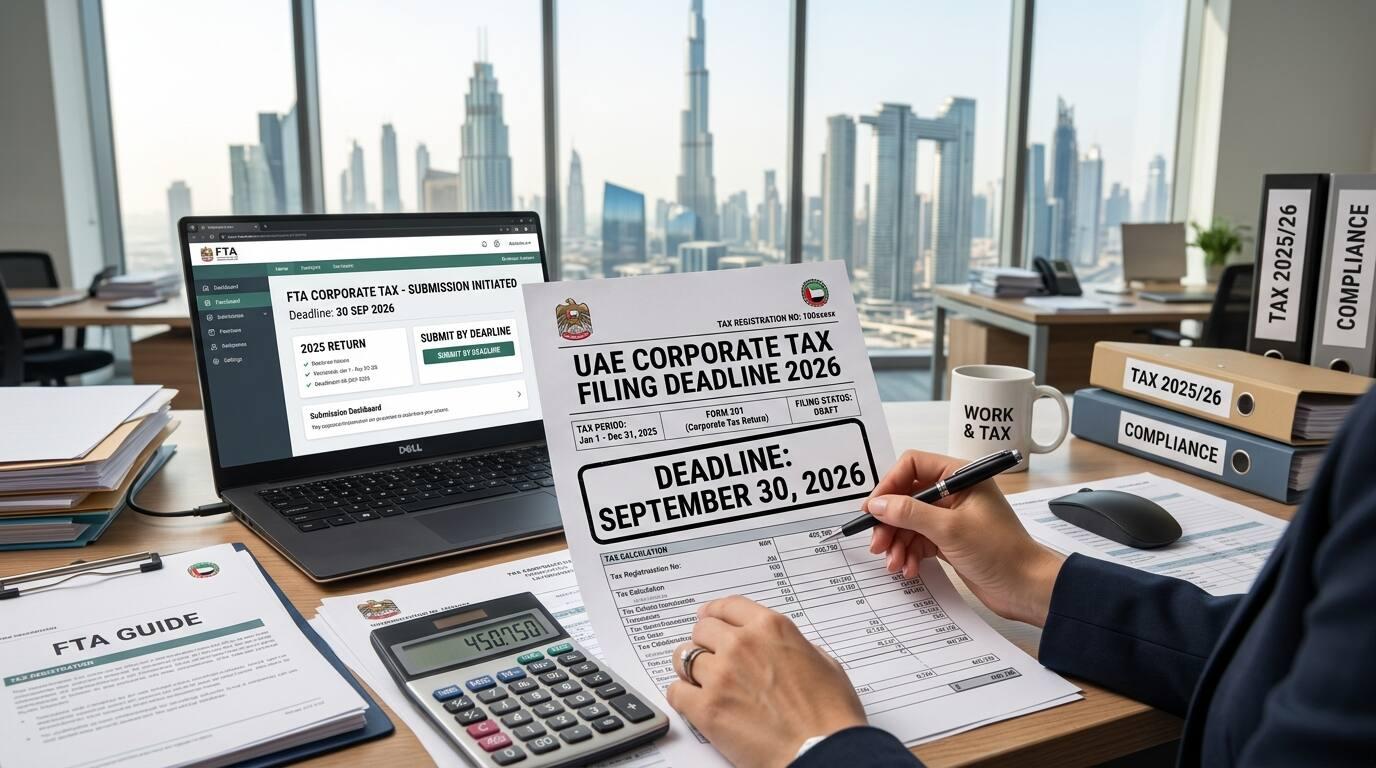
How it works: - Taxable income up to AED 375,000 is taxed at 0%. - Taxable income above AED 375,000 is taxed at 9%. - The return and any tax due are generally filed and paid within nine months of the end of the tax period. For a 31 December year-end, that is 30 September.
The FTA reports that more than 640,000 businesses are now registered for corporate tax, so tax authorities have a large and growing data set to compare against.
Small business relief
Small business relief lets eligible businesses treat themselves as having no taxable income for a period. The eligibility ceiling is annual revenue of AED 3 million. The Ministry of Finance extended the relief in August 2026 under Ministerial Decision No. 131 of 2026, so it now covers tax periods ending on or before 31 December 2029 instead of ending in 2026.
Points to keep in mind: - You must elect the relief when you file your corporate tax return. - You must still register, file returns and keep records. - Qualifying Free Zone Persons and members of larger multinational groups are not eligible. - Relief is time-limited, so a business that grows past the threshold should plan for the switch to 9% well in advance.
Free zone and mainland: the long-term trade-off
A Qualifying Free Zone Person (QFZP) pays 0% on qualifying income and 9% on everything else. To qualify, an entity must generally: - Maintain adequate substance in the free zone. - Earn qualifying income. - Keep non-qualifying revenue within the de minimis limit (5% of total revenue or AED 5 million, whichever is lower). - Comply with transfer pricing rules and documentation. - Prepare audited financial statements. - Not have elected the standard regime.
If a free zone company fails a condition, it is taxed at 9% on all its income for that year and the following four years. That is why free zone structures need monitoring every year, not just at setup. A structure that is right at launch can become costly if your customer base or revenue mix changes.
VAT: The Everyday Compliance Layer
VAT is the tax your team touches most often. Every invoice, purchase and return runs through it.
Item | Position |
Standard rate | 5% |
Mandatory registration | Taxable supplies and imports above AED 375,000 |
Voluntary registration | From AED 187,500 |
Return and payment | Within 28 days after the end of the tax period |
Portal | FTA EmaraTax |
Registration: If your turnover is approaching the threshold, or you want to recover input VAT on start-up costs, review VAT registration in UAE. Registering late is one of the most common and avoidable mistakes.
Advice: VAT treatment depends on where you supply, who the customer is, and what you sell. Experienced VAT consultants in Dubai can map your transactions and set up the right VAT codes from the start.
Filing: Monthly or quarterly returns must reconcile to your books. Dedicated VAT return filing services in Dubai reduce the risk of errors that trigger penalties or FTA queries.
Recovery: Input VAT on equipment, stock and services is cash you can recover. VAT refund services in Dubai are especially useful for businesses with large upfront investments. Recent amendments to the Tax Procedures Law introduced a five-year limit on refund and credit claims, so old balances should be reviewed now (confirm how it applies to you with the FTA or an adviser).
People: Mistakes often start with staff who raise invoices or approve purchases. Structured VAT training in UAE turns VAT knowledge into everyday habit.
E-Invoicing: The Next Big Change
The Ministry of Finance has set a phased rollout of the Electronic Invoicing System. Invoices will move through Accredited Service Providers (ASPs) in a structured digital format.
Phase | Who | Appoint an ASP by | Mandatory from |
1 | Revenue of AED 50 million or more | 30 October 2026 | 1 January 2027 |
2 | Revenue below AED 50 million | 31 March 2027 | 1 July 2027 |
3 | Government entities | 31 March 2027 | 1 October 2027 |
If you are in phase 1: the appointment date has just passed. If you have not appointed a provider, do it now and check the Ministry of Finance for any further guidance.
If you are in phase 2: you have time, but not much. Check that your accounting software can produce the required format and that your customer and supplier data is clean.
Reported penalties include AED 5,000 per month for failing to implement the system or appoint a provider on time, and AED 100 per invoice, capped at AED 5,000 a month, for failing to issue and transmit e-invoices on time.
Transfer Pricing and Global Minimum Tax: Rules for Growing Groups
Transfer pricing
If your UAE company deals with related parties, such as a parent company, a sister company in another country, or a connected person such as a shareholder, those transactions must be at arm’s length, which means priced as independent parties would price them.
Based on current published summaries: - A transfer pricing disclosure form is filed with the corporate tax return when related-party transactions exceed AED 40 million in total, or connected-person transactions exceed AED 500,000. - A Master File and Local File are required where the group’s consolidated revenue is AED 3.15 billion or more, or the entity’s own revenue is AED 200 million or more, and must be provided within 30 days of an FTA request.
Even below these thresholds, you still need to be able to justify your pricing. Specialist transfer pricing services in Dubai help you document intercompany charges before the FTA asks. Free zone entities need this particularly, because transfer pricing compliance is one of the conditions for QFZP status.
Domestic minimum top-up tax (Pillar Two)
Very large multinational groups with consolidated revenue of EUR 750 million or more in at least two of the four preceding years are subject to a 15% domestic minimum top-up tax in the UAE, for financial years starting on or after 1 January 2025. In August 2026 the Ministry of Finance issued a decision on filing obligations for the tax. Most small and mid-sized businesses are outside this regime, but if you are part of a large group, it affects your UAE profit calculations.
Penalties, Audits and Disputes: Protecting What You Build
A tax system is only predictable if you know what happens when something goes wrong.
New penalty framework from 14 April 2026. Cabinet Decision No. 129 of 2025 simplified administrative penalties across VAT, excise tax and corporate tax. According to adviser summaries, late payment now carries a flat 14% annual penalty calculated monthly (about 1.17% a month), and voluntary disclosure of an error carries 1% of the tax difference per month until it is filed. This makes early correction much cheaper than waiting for an audit.
Longer look-back in serious cases. Recent amendments allow audit and assessment periods of up to 15 years in cases of evasion, failure to register or serious non-compliance. Keep your records in good order for the full retention period (generally five years for VAT and seven years for corporate tax; confirm for your sector).
If you disagree with the FTA: - If you believe a penalty is wrong or disproportionate, see our VAT penalties reconsideration services in Dubai. - If the FTA issues an assessment you dispute, VAT assessments and appeals services in Dubai help you respond within the deadlines.
A Multi-Year Tax Roadmap for Long-Term Success
Most businesses focus on this year’s return. Long-term success comes from planning across stages.
Stage 1: Setup (year 0 to 1)
• Choose mainland, free zone or a combination with tax in mind, not only licence cost.
• Register for corporate tax and, where needed, VAT.
• Set up accounting software that supports VAT codes and, later, e-invoicing.
• Decide whether small business relief will apply and what your revenue forecast means for it.
Stage 2: Growth (years 1 to 3)
• Monitor revenue against AED 375,000 (VAT) and AED 3 million (small business relief).
• File VAT returns on time and reconcile them to the ledger before filing.
• Prepare for e-invoicing well before your phase date.
• Review input VAT claims and recover what you are owed.
Stage 3: Expansion (years 3 to 5)
• Document intercompany transactions as you add subsidiaries or foreign entities.
• Review free zone conditions every year, especially de minimis and substance.
• Check whether double tax treaties (the UAE has more than 130) can reduce foreign tax on cross-border income.
• Train finance, procurement and sales teams so tax knowledge is not held by one person.
Stage 4: Scale and exit (year 5 and beyond)
• Keep audit-ready files, since investors and buyers will run tax due diligence.
• Check whether Pillar Two or transfer pricing thresholds apply to your group.
• Plan how a sale, restructure or new investor affects your tax position.
Common Mistakes That Hurt Long-Term Growth
1. Registering late. VAT registration deadlines are strict, and late registration is penalised.
2. Assuming the free zone is automatically 0%. The benefit depends on qualifying income and conditions.
3. Ignoring small business relief limits. Revenue growth can end eligibility.
4. Treating tax as a year-end job. Errors found at year-end are harder and costlier to fix.
5. Weak supplier checks. Input VAT can be challenged if a supplier is involved in evasion and you cannot show reasonable due diligence.
6. Leaving refunds unclaimed. Cash sits idle and claims can expire.
7. Delaying e-invoicing readiness. System changes take longer than expected.
Official Government Resources
Always confirm rules against the source. Two official pages are most useful for this topic:
• Ministry of Finance: Corporate Tax in the UAE covers the corporate tax law, who is taxed, exempt persons, free zone treatment, registration, filing and payment.
• Federal Tax Authority: VAT Guides, References and Public Clarifications lists the latest VAT guides and clarifications.
Frequently Asked Questions
Conclusion
The UAE tax framework rewards businesses that plan. Corporate tax, VAT, transfer pricing and e-invoicing are separate rules, but they rely on the same foundation: accurate records, consistent numbers and timely filing. Build that foundation early, review it every year, and prepare for each new requirement before its deadline.
Pure Docs Business Consultant Services offers VAT and tax consultancy services, from VAT registration and return filing to refunds, penalty reconsideration, assessments and appeals, VAT training and transfer pricing. Contact the team to review your tax position and build a plan that supports your business for the long term.
Disclaimer: This article is for general information and does not constitute tax or legal advice. Tax rules and deadlines change, so confirm details with the Ministry of Finance, the Federal Tax Authority or a qualified adviser before acting.
Sources and references
• Ministry of Finance: Corporate Tax in the UAE
• Federal Tax Authority: VAT guides, references and public clarifications
Gulf News: UAE extends corporate tax relief for small businesses until end of 2029