




The Federal Tax Authority does not need a special reason to open a VAT audit. Any VAT-registered business in the UAE can be selected, and the FTA leans heavily on risk indicators such as mismatched filings, unusually large refund claims, or inconsistencies between VAT returns and corporate tax records. What usually decides whether an audit stays a routine formality or turns into a drawn-out, stressful process is one thing: whether the required documents are already organised and ready to produce.
In short: a VAT audit documentation checklist for UAE businesses should cover the VAT registration certificate, tax invoices, credit and debit notes, VAT return copies, general ledgers, bank statements, import and export records, the fixed asset register, and evidence for any reverse charge or zero-rated transactions. Most of these records must be kept for five years, with longer timelines for real estate and other capital assets.
Why Documentation Readiness Matters More Than the Audit Itself
A VAT audit in the UAE is a formal review of a business's tax returns and underlying records, carried out to confirm that VAT has been charged, reported and paid correctly. It can take the form of a desk audit, where the FTA reviews files submitted remotely, or a field audit, where officers examine records, accounting systems and sometimes physical stock at the business premises.
Penalties for poor recordkeeping are not limited to the tax found to be underpaid. Administrative fines apply separately for missing, late or incomplete records, and these can escalate quickly for repeated or serious breaches. Businesses that treat documentation as an ongoing habit rather than a year-end scramble consistently handle audits faster and with far less disruption to daily operations.
For businesses that want a professional review before an audit notice arrives, a VAT compliance audit in the UAE carried out in advance can identify gaps while there is still time to fix them.
The Core VAT Audit Documentation Checklist
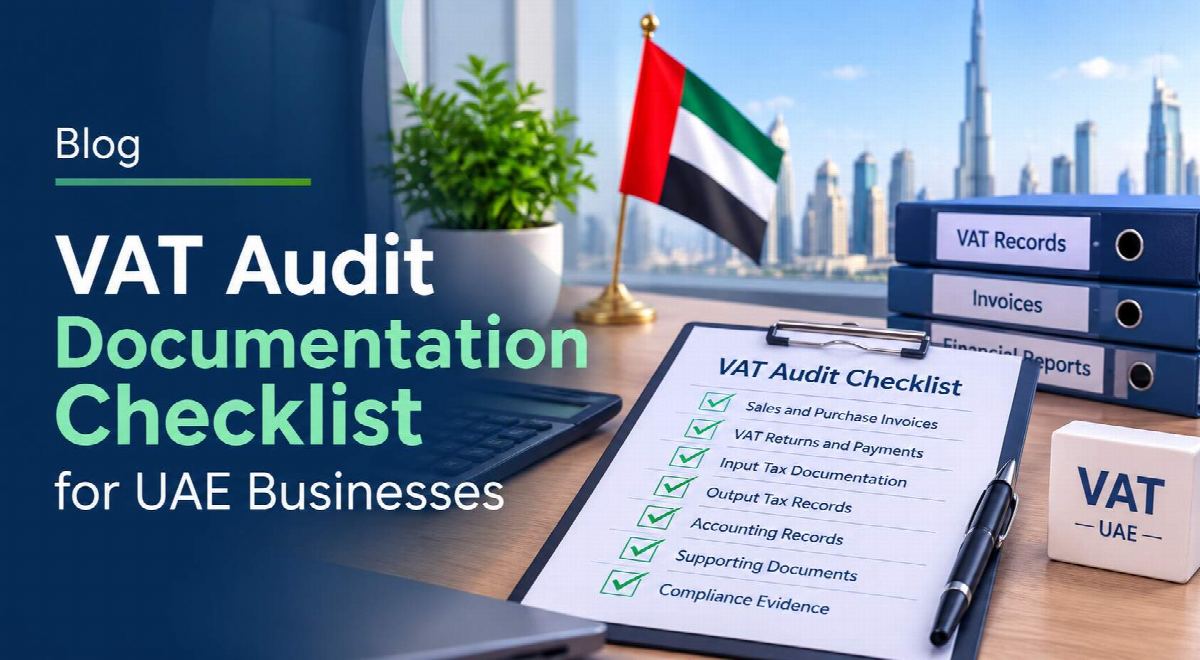
The list below reflects the categories of records the FTA most commonly requests, grouped by function so they are easier to gather and file.
1. Registration and Business Details
● VAT registration certificate and Tax Registration Number confirmation
● Trade licence and any updates to business activities or legal structure
● Details of related parties, branches or group VAT registration, if applicable
2. Tax Invoices, Credit Notes and Debit Notes
● Original tax invoices for all taxable supplies, formatted to FTA requirements
● Purchase invoices supporting input VAT claims
● Credit and debit notes with clear references back to the original invoice
● Simplified tax invoices where used, and evidence they were issued within permitted limits
3. VAT Returns and Payment Evidence
● Copies of every VAT return filed through EmaraTax, including working papers
● Payment confirmations and bank references for VAT settled
● Records of any voluntary disclosures, corrections or reassessments, together with FTA correspondence
4. General Ledger and Accounting Records
● Chart of accounts identifying which ledgers carry VAT-related balances
● Trial balances for each relevant period
● A clear audit trail linking every transaction back to a source document
5. Bank Statements and Reconciliations
● Bank statements covering the audit period
● Reconciliations between VAT returns, the general ledger and financial statements
● Explanations, with supporting evidence, for any reconciling differences
6. Import, Export and Customs Documentation
● Customs declarations matched to the VAT treatment applied on each return
● Shipping documents and proof of export for zero-rated supplies
● Reverse charge workings for imported goods and services, particularly for free zone entities
7. Fixed Asset Register and Capital Assets Scheme Records
● A fixed asset register showing acquisition dates, values and VAT treatment
● Supporting records for any assets falling under the Capital Assets Scheme, including real estate
8. Contracts and Long Term Agreements
● Copies of contracts for ongoing supplies, leases or long-term projects
● Evidence of the VAT position agreed with customers or suppliers, particularly for cross-border arrangements
9. Zero Rated, Exempt and Reverse Charge Evidence
● Supporting evidence for any zero rated or exempt treatment applied
● Reverse charge calculations and self-assessment workings for imported services
How Long UAE Businesses Must Keep VAT Records
Accurate documentation is only useful if it is retained for as long as the law requires. The table below sets out the minimum periods most UAE businesses need to plan for.
|
Record type |
Minimum retention period |
|
Standard VAT records (invoices, returns, ledgers, bank statements) |
5 years from the end of the tax period |
|
Records relating to capital assets under the Capital Assets Scheme, including real estate |
10 years from the end of the tax period in which the asset was acquired (15 years for buildings and other real estate) |
|
Corporate tax related accounting records |
7 years from the end of the relevant tax period |
Retention obligations sit alongside, not instead of, the requirement to produce documents quickly when the FTA requests them. Records stored across scattered spreadsheets or unlabelled folders rarely meet that bar, even when the underlying data is technically complete.
Common Documentation Gaps That Trigger FTA Findings
● Mismatches between figures reported on VAT returns and those in the general ledger or corporate tax filings
● Import VAT that does not reconcile against customs records
● Missing shipping documents or proof of export for zero-rated sales
● Reverse charge entries applied incorrectly or not applied at all, particularly by free zone businesses
● Input VAT claimed on invoices that do not meet FTA formatting requirements
● Voluntary disclosures or corrections that are not properly logged with supporting evidence
● Incomplete audit trails where a transaction cannot be traced from the ledger back to its source document
Building an Audit Ready File Before the FTA Asks
Businesses that stay ahead of an audit tend to follow a similar routine rather than relying on a single annual clean-up.
● Reconcile VAT accounts against the general ledger every month, not just before filing deadlines
● Store records in FTA-compliant accounting software rather than manual spreadsheets, which are harder to search and easier to get wrong
● Assign a specific person or a registered tax agent as the point of contact for FTA correspondence
● Keep a running log of corrections, credit notes and rate adjustments with clear cross references
● Run an internal review of high-risk areas, such as reverse charge and zero-rated transactions, at least twice a year
Because VAT rules touch registration, invoicing, corporate tax and free zone treatment at the same time, many businesses choose to work with a VAT Consultant Dubai to build and maintain this file rather than treating it as a one-off exercise before a filing deadline.
Desk Audits and Field Audits Call for the Same Documents, Handled Differently
The FTA generally works through the same set of core records whether the audit is remote or on-site. A desk audit is conducted through documents submitted electronically, so files need to be clean, complete, and easy to cross-reference without a live conversation to fill in gaps. A field audit adds officers reviewing systems, contracts and, in sectors such as trading or real estate, physical stock on site, so records need to match what is actually held in the warehouse or on the balance sheet.
Frequently Asked Questions
Getting Audit Ready Without the Guesswork
A VAT audit is far less disruptive when the underlying documentation has been organised as a matter of routine, rather than assembled in a rush once an audit notice arrives. Businesses setting up or restructuring in the UAE often find it easier to build good VAT habits early with the support of an experienced Business Setup consultant in Dubai, who can align registration, accounting and VAT documentation from the outset rather than retrofitting compliance later.
Pure Docs Business Consultant Services also offers investor visa consultancy services in the UAE, helping business owners and investors handle their visa requirements alongside their tax and company compliance needs, so that both the business and the individuals behind it stay fully compliant as they grow.



Get Expert Business Support
Share your requirements with us, and our team will help you find the right solution for your business in the UAE.

Address:
Royal House Building - Block A - M8 Floor - Office No 20 - Hor Al Anz - Dubai - United Arab Emirates
Monday To Saturday: 9:00 AM - 8:30 PM
 +971 501 154 886
 Contact on Whatsapp
Social Links:


